WEEK 13 ~ DECK PREP
Message to the Class
First, thank you all for the seriousness, creativity, and courage you brought to these pitch decks. The quality of the work made this a difficult decision. There were multiple projects here with real promise, strong personal conviction, and meaningful social intent.
Because the innovation tournament only allows us to advance two projects, the choice had to come down to a few key questions: Which ideas most clearly express the mission of this class? Which ones show the strongest combination of social purpose, systems awareness, stakeholder empathy, and venture readiness? And which two, together, best represent the range of thinking happening in our course?
With that in mind, the two projects selected are The Conduit and Bloom After Birth.
Why these two were chosen
The Conduit
The Conduit stood out because it addresses a systems-level problem rather than only an individual pain point. The deck identifies a major gap between university research and real-world commercialization, then builds a coherent model around funding, building, and securing the path from research to market. It also shows stronger-than-average strategic structure through its business model, competition framing, and KPI thinking. In the context of this class, that matters. It reflects the idea that social entrepreneurship can be about redesigning institutions and unlocking stranded value, not just launching an app or service.
Bloom After Birth
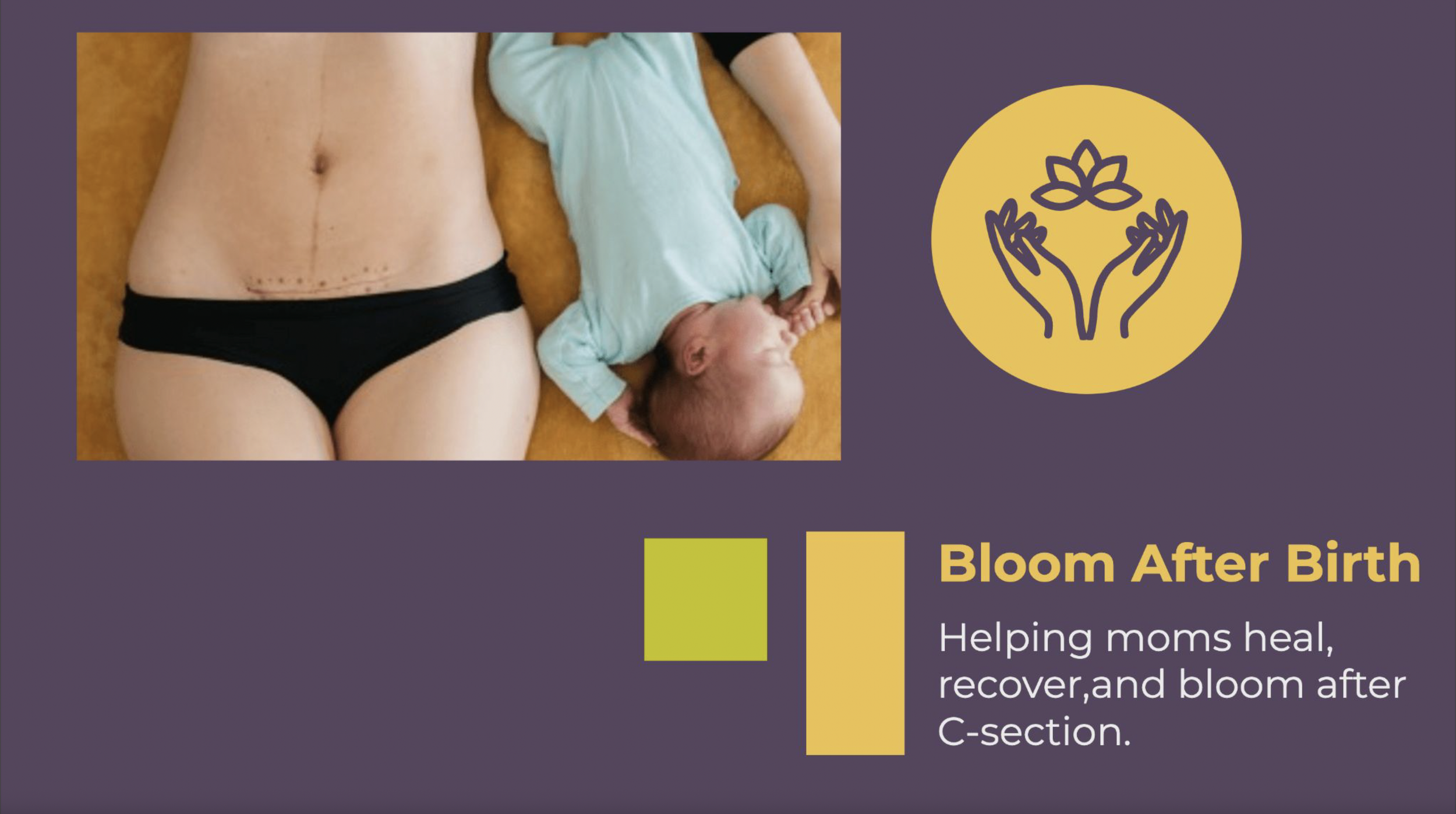
Bloom After Birth stood out because it is highly human-centered, specific, and timely. It focuses on a real gap in postpartum recovery for mothers after C-section and proposes a solution that is narrow enough to be understandable and potentially actionable. The deck also makes a good effort to connect the user problem, solution, business model, and competition. As a result, it feels both compassionate and venture-oriented, which is exactly the balance we want students in this class to practice.
Why this pairing makes sense for the class
Together, these two projects create a strong and diverse representation of the course. The Conduit represents institutional and structural innovation. Bloom After Birth represents care-centered, user-facing innovation. One tackles a breakdown in the innovation pipeline; the other tackles a neglected health-recovery experience. That diversity matters. It shows that social entrepreneurship can operate at different levels—systems, institutions, services, and communities—while still staying grounded in mission.
A note to everyone else: strong work, real promise
Not being selected for the tournament is not a statement that your idea lacks value. In several cases, the difference came down to readiness, clarity, or proof, not heart or originality. Many of the projects in this class had strong cores and could become significantly stronger with one more round of refinement.
Root & Rise
Root & Rise was one of the strongest mission-driven projects in the class. It showed real empathy and a powerful reframing of the foster-youth transition challenge from short-term survival to long-term asset-building. The reason it was not selected is not because the mission was weak. It was because the deck still needs more execution detail: clearer economics, harder outcome metrics, and a sharper pilot plan. The core idea is excellent and worth continuing.
Transform
Transform addressed a relevant and growing women’s-health issue and brought strong personal motivation to the table. It showed instinct for partnerships, referrals, and market opportunity. Where it fell short was specificity. The concept needs a more clearly defined service model, stronger differentiation, and a clearer explanation of how the venture would operate in practice. The topic is strong; the next step is tightening the model.
N-SECC
N-SECC was energetic, polished, and highly presentable. It had strong visual identity and a clear understanding of event revenue streams. It fell short mainly because it read more as a promising event business than as a clearly defined social-entrepreneurship intervention with a deep theory of change. The idea has potential, especially as a platform-builder, but it needs a stronger articulation of long-term social impact.
AETHER
AETHER was one of the most ambitious and intellectually bold decks in the group. It clearly thought at infrastructure scale and made a memorable argument. The challenge was that its social mission and its operating mechanism were not fully aligned. When a model depends on very broad personal-data extraction, that creates ethical tension that is hard to ignore in a course centered on socially responsible entrepreneurship. The project is imaginative, but it would need a stronger ethical redesign to represent the class publicly.
Ridare
Ridare tackled a real public-safety issue and showed a sincere effort to connect individual behavior change with community well-being. Its strengths were clarity of intent and a thoughtful value proposition. It fell short because the market is crowded and the deck did not yet prove why users, cities, or law-enforcement partners would choose this solution over existing navigation and safety tools. The next stage is differentiation and partnership proof.
Cell-cultured meat / restaurant bioreactor concept
This project deserves recognition for thinking at planetary scale. It took on climate, emissions, and the meat industry with boldness. Its limitation was feasibility. The deck itself acknowledged that costs and production details remain unclear, which made the concept feel more visionary than tournament-ready. Big vision is a strength; the next step is grounding that vision in a more concrete first-stage venture plan.
Closing message to the class
What I hope everyone takes from this process is that a strong social venture needs more than passion and more than a good cause. It needs a clear problem, a specific user or stakeholder, a solution that is believable, a model that can sustain itself, and evidence that the team understands what it would take to execute.
That is what made these decisions difficult, and that is also what made this cohort impressive. There is real talent in this room. The selected teams should feel proud, and the non-selected teams should also feel encouraged: many of these ideas are one revision away from being much more competitive.
Thank you again for the thoughtfulness you brought to this work.
INNOVATION TOURNAMENT STRIKE PLAN:
BREAK OUT INTO YOUR TEAMS
INTEGRATE AND DELEGATE NOTES FROM TODAY’S CLASS
SCHEDULE PRACTICE PITCH SESSION - ENTIRE TEAM IF POSSIBLE
Absolutely. Here is a recommended strike plan you can give the Team Leaders for The Conduit and Bloom After Birth as they direct up to four classmates to help strengthen the final tournament decks.
Assumption: each selected team has 1 Team Leader + up to 4 student support members, and the Team Leader has final decision-making authority.
Innovation Tournament Strike Plan
For Team Leaders and Student Support Teams
Mission
Your job is not to reinvent the venture. Your job is to make the deck clearer, stronger, more credible, and more presentation-ready.
By presentation day, the deck should do six things well:
Define the problem clearly.
Show who is affected and why it matters.
Present a focused solution.
Prove the model is viable.
Show why this team can execute.
Leave the audience with a memorable takeaway and a clear ask.
The Team Leader owns the vision. The support team exists to sharpen it.
Command Structure
Each Team Leader should assign the following roles:
1. Story Lead
Owns flow, logic, and slide order.
This person asks: does the deck tell one strong story from beginning to end?
2. Evidence Lead
Owns facts, sources, numbers, and credibility.
This person checks claims, strengthens weak assumptions, and makes sure the pitch sounds defensible.
3. Design Lead
Owns slide clarity, visuals, consistency, readability, and pacing.
This person simplifies clutter, improves slide hierarchy, and makes sure every slide can be understood in seconds.
4. Presentation Lead
Owns speaker notes, timing, transitions, Q&A prep, and live delivery coaching.
This person helps the presenter sound confident, concise, and tournament-ready.
If a team has fewer than four helpers, combine roles:
3 helpers: combine Evidence + Design
2 helpers: combine Story + Presentation, and Evidence + Design
Rules of Engagement
The support team should follow five rules:
1. One voice, one final call.
The Team Leader decides. Helpers advise.
2. Fix the biggest problems first.
Do not waste time polishing slides that are not strategically important.
3. No unverified claims.
If a number cannot be defended, remove it or qualify it.
4. Do not add complexity late.
The goal is clarity, not more content.
5. Every slide must earn its place.
If a slide does not move the pitch forward, cut it.
The Five-Phase Strike Plan
Phase 1: Triage Session
Goal: identify the 3–5 highest-priority weaknesses.
Hold one working session led by the Team Leader.
Go slide by slide and answer:
What is the strongest part of this deck?
Where does the story get confusing?
Which claims feel weakest or most vulnerable?
What is missing for a judge to believe this?
What one thing must the audience remember?
At the end of the session, produce:
Top 3 priority fixes
Ownership for each fix
A deadline for revised materials
Triage questions for both teams
Is the problem statement sharp enough?
Is the solution specific enough?
Is the business model believable?
Does the team slide increase or reduce credibility?
Are the metrics concrete and relevant?
Is the closing memorable?
Phase 2: Structural Rewrite
Goal: make the deck flow like a persuasive narrative.
The Story Lead should help rebuild the deck around this sequence:
Problem
Why this problem matters now
Who is affected
Solution
Why this solution is different
Business/revenue model
Go-to-market
Team credibility
Metrics / proof of success
Ask / closing
The Team Leader should be ruthless here.
If the deck wanders, compress it.
If the audience has to work to understand it, simplify it.
Output of Phase 2
Clean slide order
Updated headings
Shorter, sharper talking points
Any unnecessary slides removed
Phase 3: Credibility and Proof Upgrade
Goal: make the pitch believable under scrutiny.
The Evidence Lead should work through every major claim and ask:
What evidence supports this?
Is this a real number, estimate, or aspiration?
Does the deck distinguish between pilot goals and long-term goals?
What would a judge challenge immediately?
The support team should create a backup fact sheet even if those details do not all appear on the slides.
Output of Phase 3
Revised metrics
Clean numbers
Consistent assumptions
1-page Q&A prep sheet
1-page source/assumption sheet
Phase 4: Visual Compression
Goal: make every slide easy to understand in 3–5 seconds.
The Design Lead should apply these rules:
One idea per slide
Fewer words
Bigger headlines
Strong visual hierarchy
Consistent fonts, spacing, and colors
No overcrowded slides
Replace paragraphs with short phrases where possible
The test: if someone sees the slide for five seconds, do they understand its purpose?
Output of Phase 4
Final visual draft
Simplified charts/tables
More readable team and financial slides
Clean title and closing slides
Phase 5: Rehearsal and Red Teaming
Goal: prepare the presenter to win the room.
The Presentation Lead should run:
1 timing rehearsal
1 clarity rehearsal
1 hostile Q&A rehearsal
The support team should ask the hardest likely questions:
Why this and not existing alternatives?
Why now?
What is the first pilot?
Why will users/customers adopt?
What assumptions are least certain?
Why is this team the right team?
Output of Phase 5
Final talk track
Tight opening and closing
5 strongest answers ready for Q&A
Presentation under time limit
Recommended Work Plan by Team
Team 1: The Conduit
The Conduit already has a strong systems-level idea and a bold frame. Its support team should focus on making it more credible, more grounded, and easier to follow.
Priority objectives
1. Tighten the core story.
The deck has ambition and structure, but it can still sound abstract. The team should simplify the story into one sentence:
Universities produce high-value research, but most of it never reaches the market. The Conduit is a bridge that funds, builds, and commercializes academic innovation faster and more effectively.
2. Strengthen proof.
The problem slide makes strong claims about R&D spend, patent failure, and lost value. Those need to sound precise and defensible.
3. Ground the business model in a pilot.
The biggest improvement would be showing what the first version looks like:
first university partner
first researcher profile
first revenue stream
first measurable milestone
4. Humanize the venture.
Right now the deck is structurally strong, but it should show more clearly who benefits:
student researchers
universities
corporate partners
society through faster translation of innovation
5. Rework the team slide.
The current team descriptions feel high-powered but overly polished and may invite skepticism if not backed up. The support team should help make the team slide sound real, specific, and credible.
Best use of the four support members
Story Lead: simplify the arc and reduce jargon
Evidence Lead: verify research/commercialization claims and KPI assumptions
Design Lead: declutter text-heavy slides, especially problem/business model/team
Presentation Lead: prepare answers to “Why is this actually feasible?”
Questions the Conduit team must be ready to answer
Why would a university trust you?
Why would a top researcher choose this path?
What is your first pilot?
What part of the model works first, even at small scale?
What is the clearest proof this is more than a concept?
Team 2: Bloom After Birth
Bloom After Birth already has strong empathy and a focused user problem. Its support team should focus on making it more credible, more clinically grounded, and more operationally sharp.
Priority objectives
1. Clarify the user journey.
The deck should show exactly what happens:
mother has a C-section
she downloads / is referred into Bloom
she receives recovery guidance, tracking, support, and education
the app improves confidence, adherence, and recovery experience
2. Clean up the team slide immediately.
This is the highest-priority fix. The team slide currently creates credibility risk. It needs to reflect real, appropriate, and clearly explained roles.
3. Add clinical guardrails.
The judges will want to know:
Is this medical advice or educational support?
Who creates the content?
How do users know when to seek professional care?
What is the boundary between community support and clinical care?
4. Make the business model more believable.
The monthly subscription plus insurance partnership concept is promising, but the financial logic should be cleaner and more transparent.
5. Strengthen differentiation.
The deck already contrasts itself with broader platforms. It should now say, even more clearly:
Bloom is not general postpartum content. It is structured, C-section-specific recovery support.
Best use of the four support members
Story Lead: sharpen the pain-to-solution flow and the postpartum journey
Evidence Lead: strengthen C-section recovery data, maternal health framing, and assumptions
Design Lead: simplify slides and emphasize emotional clarity without overcrowding
Presentation Lead: prepare answers to “Why will providers or insurers care?”
Questions the Bloom team must be ready to answer
Why is this better than current discharge instructions?
Who pays first: moms, providers, or insurers?
What is the first partnership you need?
How do you ensure safe information?
What outcome improves because of this product?
Deliverables Each Support Team Should Produce
By the end of the strike process, each Team Leader should have:
1. Final tournament deck
Clean, concise, readable, polished
2. Speaker notes
What is said on each slide, in order
3. Q&A sheet
Top 10 likely questions with prepared responses
4. Assumptions / evidence sheet
Key numbers and what supports them
5. Final slide checklist
readable
credible
on-brand
timed
persuasive
Recommended 3-Round Review Cycle
Round 1: Content
Is the logic strong?
Round 2: Design
Is the deck clean and readable?
Round 3: Performance
Can it win live?
If something does not help all three, it is probably not a priority.
Final 24-Hour Checklist
The day before presentation, the Team Leader should confirm:
The deck tells one clear story
The first 30 seconds are strong
The close is memorable
The presenter can explain the business model simply
Weak claims have been fixed or removed
Timing is under control
Q&A answers are practiced
No slide feels confusing or crowded
Bottom Line
The support teams should operate like a small strike unit, not a committee.
Their mission is to help the Team Leader do three things:
clarify the story, strengthen the proof, and sharpen the delivery.
That is what will move a good deck into tournament shape.